
How to organize shoes in small closet comes down to two things: deciding what truly earns shelf space, and using storage that fits your closet’s shape instead of fighting it. You don’t need a bigger closet, you need fewer “mystery piles” and a system you’ll actually keep using.
A cramped shoe setup usually creates the same daily annoyances: crushed toes, scuffed heels, missing pairs, and that moment when you buy a duplicate because you “can’t find” the ones you own. It also quietly steals closet space from everything else.
This guide walks through a practical plan, from a fast edit of what stays to specific layout options, with a few honest trade-offs so you can pick what works in your home, not what looks perfect online.
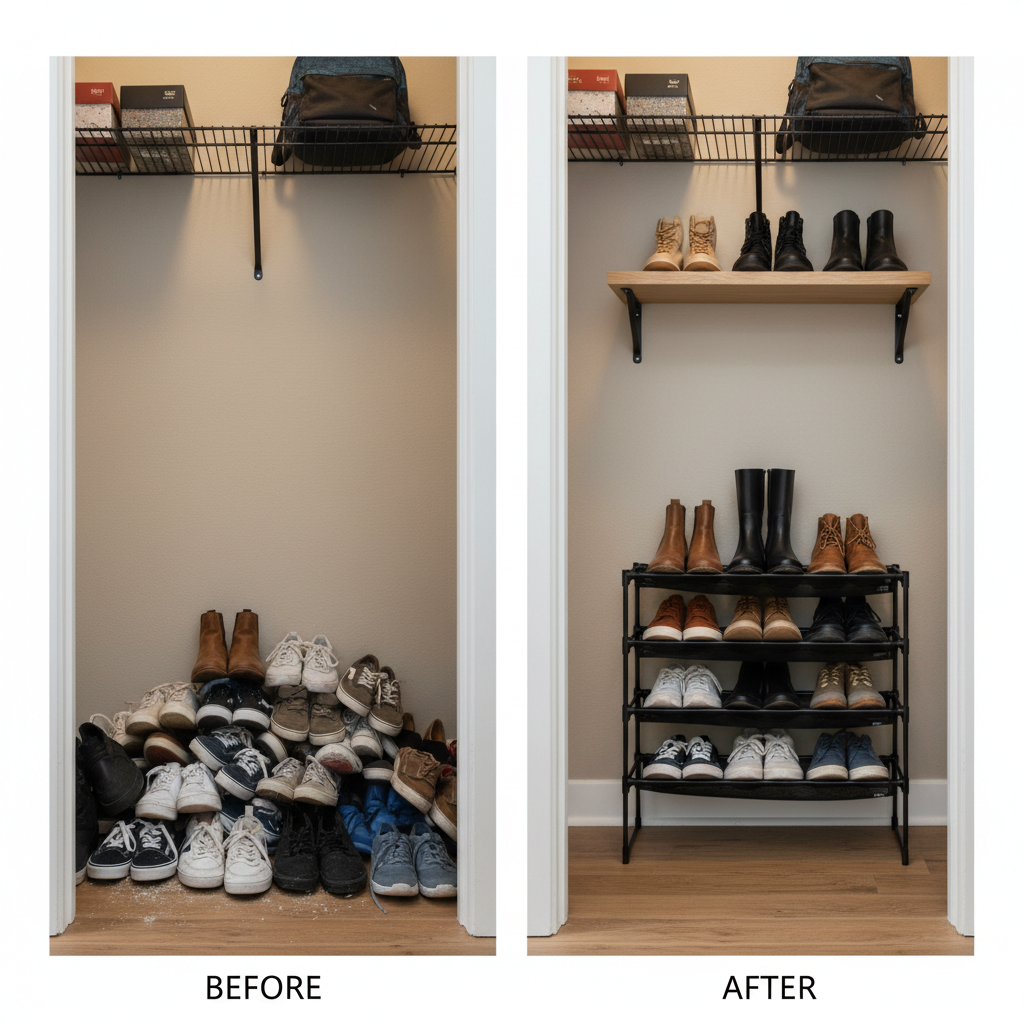
Why small closets get overwhelmed (and what’s really happening)
Most people blame the closet size, but the mess usually comes from a few predictable patterns.
- Too many “almost daily” pairs: Sneakers, work shoes, gym shoes, slip-ons, and seasonal boots all try to live in the same prime spot.
- No single “landing zone”: Shoes come off wherever you stand, then migrate into piles because there’s no one spot that feels easier.
- Wrong scale storage: Deep bins and bulky racks waste inches in tight spaces, and those inches matter more than you think.
- Visibility problems: If you can’t see pairs at a glance, you stop putting them away, then the system collapses.
According to OSHA, good housekeeping reduces trip hazards, and shoes left on walking paths are a classic way small spaces become risky. You don’t need to turn your closet into a safety project, but it’s a helpful reminder that clear floors are not just “aesthetic.”
A quick self-check: what kind of shoe chaos do you have?
Before buying anything, pin down which situation you’re in. It changes the solution.
- Floor-pile problem: Most shoes live on the closet floor, blocking access to clothes.
- Pair-separation problem: You have storage, but pairs get split up and you waste time hunting.
- Seasonal overflow problem: Your everyday setup works until boots, rain shoes, or sandals rotate in.
- “Special occasion” creep: Heels, dress shoes, or rarely worn pairs multiply because they’re out of sight.
If your answer is “all of the above,” that’s common. Start with everyday pairs, then handle seasonal and special-occasion storage once the core feels stable.
Step 1: Edit your shoe inventory (keep it realistic, not aspirational)
If you’re serious about how to organize shoes in small closet, you need a quick filter. Otherwise any rack turns into a crowded rack.
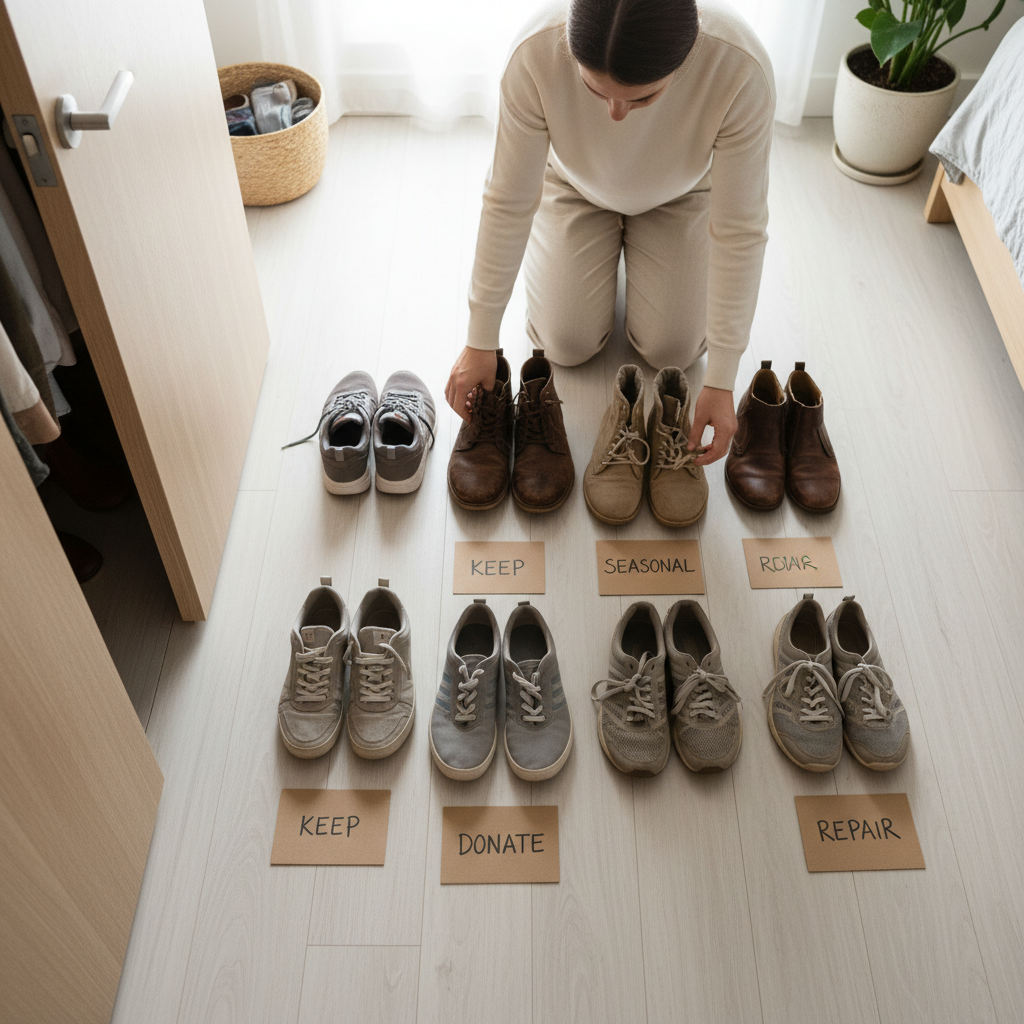
A simple 10-minute sort
- Daily/weekly: shoes you wear most weeks.
- Occasional: events, interviews, weddings, date nights.
- Seasonal: boots, snow shoes, summer sandals.
- Exit pile: uncomfortable, damaged beyond repair, or never chosen.
Be blunt with the “exit pile.” If something hurts your feet, it usually stays unworn. If you have foot pain or medical concerns, it’s smart to check with a podiatrist or qualified professional before forcing yourself into “cute but painful” pairs.
Step 2: Choose a storage method that matches your closet layout
There’s no single “best” organizer. The right pick depends on how much floor space you can spare, and whether you need vertical storage, door storage, or shelf storage.
Best options, with honest trade-offs
| Storage option | Works best for | Watch out for |
|---|---|---|
| Slim shoe rack (2–3 tiers) | Everyday sneakers, flats, low shoes | Can eat floor space if the closet is very shallow |
| Over-the-door pocket organizer | Light shoes, sandals, kids shoes | May not fit bulky shoes, door may not close smoothly |
| Stackable clear shoe boxes | Keeping pairs visible, dust control | Takes time to put away, boxes can slide if not uniform |
| Under-shelf hanging organizer | Adding a “bonus level” under an existing shelf | Only works if you already have a shelf and enough height below |
| Boot shapers + vertical boot row | Keeping boots from slouching and cracking | Still needs a dedicated zone, boots are space-hungry |
Small closet tip that rarely gets said out loud: if you hate “putting shoes in boxes,” you won’t maintain clear boxes, even if they look great on day one.
Step 3: Set up zones: daily, occasional, seasonal (so shoes stop migrating)
The fastest way to make how to organize shoes in small closet stick is zoning. You’re trying to reduce decisions, not create more rules.
A layout that works in many small closets
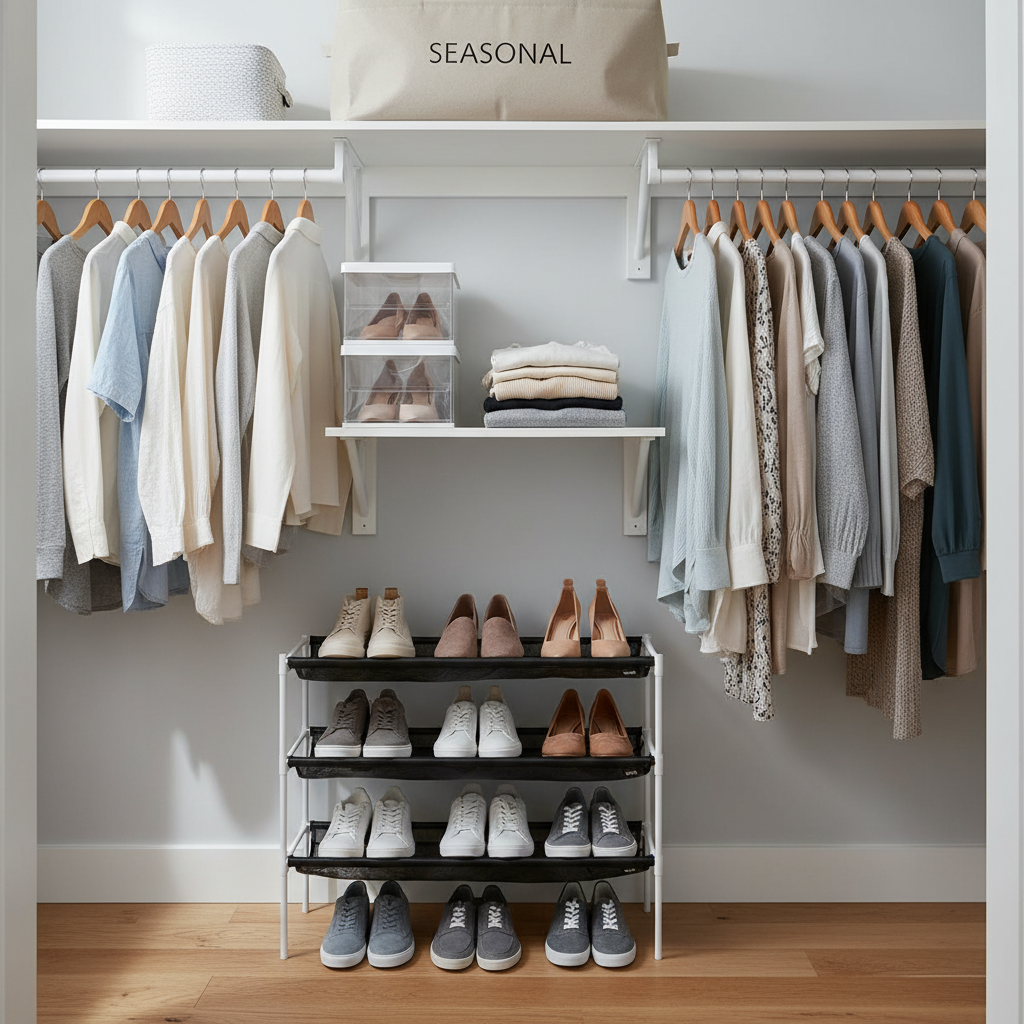
- Prime zone (eye to knee height): daily/weekly pairs, easiest to grab.
- Upper zone: occasional shoes in labeled boxes or a small bin.
- Lower/back zone: seasonal items, boots, or backup sneakers.
If your closet has a single shelf and a clothing rod, try placing a slim rack directly under hanging clothes, then keep one small bin on the shelf for “occasionals.” The goal is to avoid the floor becoming an unplanned zone.
Space-saving tricks that actually make a difference
These are the moves that save inches, which is what small closets run on.
- Use one shoe riser per “favorite pair”: it doubles vertical capacity without turning into a wobbly stack.
- Turn pairs sideways only when needed: it can fit more, but it slows you down, so reserve it for occasional shoes.
- Adopt a “one in, one out” rule for the prime zone: when a new daily pair enters, one daily pair moves to occasional or exits.
- Keep shoe-care nearby: a small cloth and deodorizer in a bin reduces the urge to toss shoes on the floor “to air out.”
According to CDC guidance on indoor air quality and ventilation, reducing moisture buildup helps prevent odors and related issues. In practical terms, let damp shoes dry before boxing them up, and consider a breathable setup for gym shoes.
Real-world setup examples (pick one and commit for two weeks)
If you’re stuck, choose a template. Perfection usually shows up after a couple of mornings of use.
Template A: The “No-floor-clutter” setup
- 2-tier slim rack for 6–10 daily pairs
- One over-the-door organizer for flats/sandals
- One labeled bin on the top shelf for seasonal rotation
Template B: The “Everything visible” setup
- Uniform clear boxes for occasional shoes
- Daily shoes stay unboxed on one shelf or rack
- Photo labels for similar-looking pairs (black flats all look the same at 7 a.m.)
Template C: The “Boot-friendly” setup
- Boots lined at one side, supported with boot shapers
- Sneakers on a slim rack
- Heels in boxes up high to avoid scuffs
Common mistakes that make shoe organization fail
- Buying storage before editing: you end up organizing clutter, not solving it.
- Overfilling the prime zone: daily access becomes annoying, so shoes drift back to the floor.
- Ignoring your actual habits: if you never open boxes on weekdays, don’t make weekdays depend on boxes.
- Storing damp shoes: it can lead to odor and material damage, especially with leather and suede.
One more subtle issue, storing heavy shoes up high can be annoying and sometimes unsafe. If you’ve got mobility concerns, it’s worth keeping heavier pairs within easy reach and asking a professional organizer for a safer layout.
Key takeaways (so you can act today)
- Clear categories beat fancy containers: daily, occasional, seasonal is enough for most homes.
- Prime space goes to frequent shoes, everything else earns a less convenient spot.
- Pick storage you’ll maintain, not what looks best in photos.
- Commit for two weeks, then adjust based on what keeps ending up on the floor.
Once you know how to organize shoes in small closet, the real win is consistency: fewer piles, faster mornings, and shoes that last longer because they’re not getting crushed.
If you want a simple next step, start by sorting into four piles, then set up one clear “daily zone” you can reach without moving anything else. Tomorrow morning will tell you if it works.
FAQ
How do I organize shoes in a small closet without buying anything?
Start with a strict daily zone using what you have: line up daily pairs toe-out along one wall, put occasional shoes in a shoebox or any small bin up high, and move seasonal shoes to a separate container. The key is keeping the floor from becoming “miscellaneous.”
What’s the best way to store shoes on a closet floor?
A slim, low rack usually beats stacking pairs directly on the floor because it keeps pairs together and creates a boundary. If your closet is extremely shallow, a single row plus a shoe riser for your top two pairs can still help.
Are clear shoe boxes worth it for small closets?
They can be, especially for occasional shoes you don’t want crushed. But many people stop using them if mornings feel rushed. If you try boxes, keep daily shoes unboxed and reserve boxes for the “not every week” category.
How many shoes should I keep in a small closet?
It depends on lifestyle and seasons, but a practical limit is whatever fits while leaving breathing room: daily pairs should be easy to grab with one hand, and occasional pairs should store without bending or crushing. If you’re constantly forcing items in, that’s your signal to edit.
How do I organize boots in a small closet?
Give boots a dedicated vertical zone and use boot shapers or rolled towels to prevent slouching. If tall boots don’t fit, store them seasonally on a top shelf in a bin, but only after they’re fully dry and clean.
Where should seasonal shoes go if I have no extra storage space?
Use the least convenient closet zone: highest shelf or the far back under hanging clothes. If that still fails, rotate by moving one seasonal category out, even into a labeled under-bed bag, so the closet stays functional.
How can I stop my shoe organization system from falling apart?
Make “put away” easier than “drop on floor.” Keep the daily zone closest to where you naturally take shoes off, limit that zone to a set number of pairs, and do a 2-minute reset once a week.
If you’re trying to organize shoes in a small closet and keep hitting the same bottleneck, it may help to map your closet measurements and shoe mix, then pick a storage combo that matches your habits, not someone else’s. If you want a more hands-off option, a short list of your daily pairs plus a simple zone plan can make shopping for organizers much less trial-and-error.